
October 23, 2026
The original plan was smart, focused and responsible.
Three days in New York City researching European-ish (mostly French) patisseries, bakeries, wine bars, cafés, and markets for a new bakery, bread lab, wine bar, patisserie and market we’re designing.
The best way to learn is to go see things firsthand. Photos can show you what a space looks like. They cannot tell you how it smells when the first croissants come out of the oven, where people naturally stand, what they grab first, how long they linger, whether the chairs encourage a twenty-minute coffee or a three-hour hostage situation, or why one place feels alive and another feels like an expensive refrigerator.
You have to be there, so we were going.
The cast of characters: David and me on design (Shea Design), and John and Elizabeth as owners of the new place we were designing.
John—whom we call Bubba—has actual street cred. Internationally acclaimed pastry chef. Nearly a decade teaching at the French Pastry School in Chicago. First American-born member of the very exclusive Relais Desserts. Former captain of the U.S. team at the Coupe du Monde de la Pâtisserie.
In short, Bubba is the shit in the pastry/bakery world. He is also from Paducah, Kentucky. Hence the nickname Bubba.
Betty (aka Elizabeth) comes from a luxury goods retail background. She has an eagle eye for every detail and laser sharp opinion. They own and operate two incredible places already, Patisserie 46 and Rose Street Patisserie.
Our stated mission was to study everything: menu mix, display, packaging, service, branding, product quality, seating, flow, lighting, materials, what was fresh, what felt tired and what made us want to stay.
Then we started building the Google map. That’s when things deteriorated.
We decided we should book multiple lunch and dinner reservations every day—not to cancel one, rather to literally eat at two -three places. Choosing was a sign of weakness.
Then Bubba and I added pizza.
Because New York.
Because we both love pizza.
Because neither of us possesses meaningful restraint around food.
My preferred food groups are remarkably similar to those of a thirteen-year-old boy: pizza, tacos, pastries, ham-and-cheese sandwiches and peanut M&M’s. Butterfingers would probably outrank the M&M’s, but they’re harder to eat discreetly.
Eating this way is not sustainable for adult humans, it mostly makes you feel sick. So I saw New York as my window. NYC had become one giant dog park with a no-leash policy.
I was a French bulldog. Bubba, my partner in crime, was a Shiloh Shepherd.
Our shared Google map looked like evidence from a federal investigation.
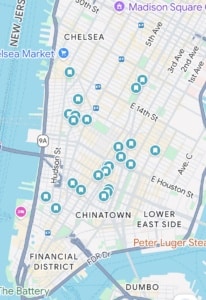
We were ready.
DAY ZERO: STILL DIGNIFIED
We arrived late enough that the first day remained relatively civilized.
First stop: Meadow Lane in Tribeca to look at display and packaging. Then a drink at Weather Up on the way to dinner at The Odeon, the timeless Tribeca brasserie that has somehow been packed since 1980.
We all remembered it from years past, and Betty was a regular when she lived in NYC. And it was still packed even on a Monday night. That matters.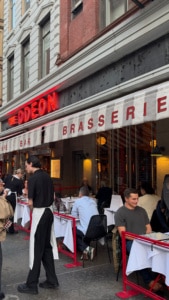
Any restaurant that survives four decades and still feels relevant is worth paying attention to. What still works? What hasn’t been over-designed? What feels effortless but probably isn’t?
We noticed everything. Then we ordered three not-small desserts. Profiteroles. Chocolate cake. Sticky toffee pudding.
After dinner, we introduced Bubba and Betty to an important field tool: Amaro. For digestion.
We needed all available assistance for survival.
DAY ONE: ALL RESTRAINT IS LOST
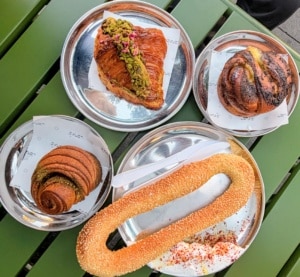
We started at 7:30 a.m. because that’s when Librae Bakery opens.
First stop. Six pastries. No limits, we needed to come out of the gates strong.
The Jerusalem bagel and babka bun were spectacular. The famous rose-pistachio croissant was good, but for us, there was a little too much that overwhelmed the incredible croissant.
The important discovery wasn’t just what tasted best, it was timing. When you arrive the moment a bakery opens, everything is warm. And there may be nothing better in the world than eating pastry that came out of the oven minutes ago.
That also creates an entirely different retail experience.
You smell it.
You see trays moving.
There’s urgency.
You desperately need something you didn’t know you wanted thirty seconds earlier.
As we were clearing our table, Bubba and I spotted a breakfast focaccia coming out of the oven. We froze.
Betty intervened and said, “We have to pace ourselves,” although with a bit more colorful language.
Apparently the dog park had acquired a leash law.
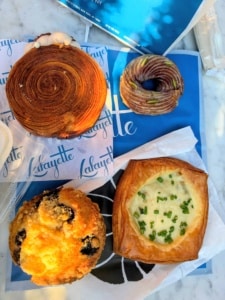
Then Lafayette Bakery, which has also been around quite a while.
Quiche for what we optimistically called sustenance.
Crullers. Croissants. A Danish de jour. Muffins. New York roll (filled, rolled croissant dough).
The croissant was fresh from the oven. Bubba declared it “not bad.” From a pastry chef at his level, this is approximately a standing ovation. Warm croissants are hard to beat.
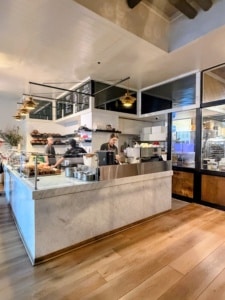
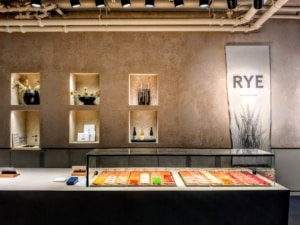
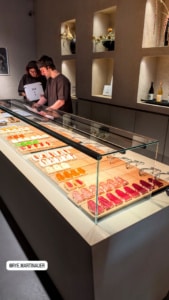
Next came Rye by Martin Auer and its much-discussed $60 loaf of rye.
The space looked like a high-end jewelry store where slices of bread with various toppings had replaced diamonds. That was the point. Minimal product. Precious presentation. Heavy emphasis on theater for the entire experience.
Rye bread itself remains somewhat lost on me, but the toppings were colorful, tasty and creative. Bubba thought the bread was excellent and wanted to buy the loaf. Betty vetoed. Strongly, in the form of “NO F’ing way you’re carrying around a giant loaf of bread.”
Then across the Street to La Cabra for cardamom buns. My notes here are highly technical: OMG good.
Sant Ambroeus followed so we could see what the Italians were doing with pastry, cakes, sandwiches in an international restaurant and cafe that now seems to have colonized Manhattan.
Solid. Very popular. Clearly working.
Bubba and I peered into Ceres pizza and immediately started trying to wedge it in before our actual lunch reservation at Balthazar. Sadly, it wasn’t open until noon so we’d have to strategize how to come back.
By our next stop at Frenchette Bakery, the seams were starting to come apart.
Financiers. Croissants. Canelés.
We bought them for “later,” which had become a fictional time period when our digestive systems would magically reset themselves.
I desperately wanted a ham-and-cheese sandwich because they nailed that display. And again: it’s a food group.
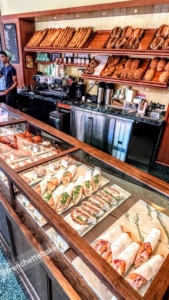
Betty and I were looking forward to Champagne at lunch. At this point, it was less indulgence than coping mechanism. David, who had wisely eaten very little pastry, was the only person genuinely hungry.
So off to Balthazar, another now NYC classic that stands the test of time. Champagne all around and I got my ham-and-cheese sandwich.
The others attempted to introduce protein and vegetables into their systems.
Cop outs, all of them.
THE AFTERNOON SHIFT
We took a break after lunch to get some work done and remind ourselves that technically we had jobs.
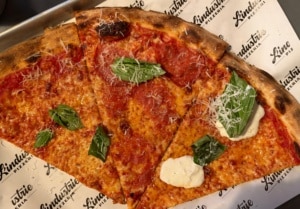
The plan was to reconvene at 4:00 for round two, and we started with L’Industrie pizza.
Three giant New York slices. Nearly gone.
Since we were somehow ahead of schedule because the notoriously long line at L’Industrie was only three deep, we added Via Carota as a pre-dinner snack. Pizza does not count as a meal when you are conducting research. Please respect the methodology.
We put our names down at Via Carota, had drinks at the adorable corner Bar Pisellino, ate apre-dinner at Via Carota, then proceeded to actual dinner at Le Sixth, a relative newcomer.
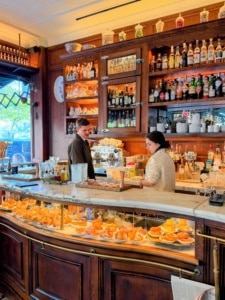
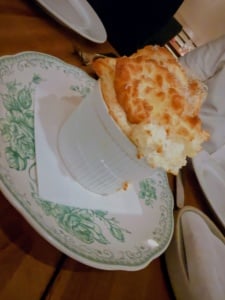
Dinner included three desserts, naturally. Chocolate soufflé finished what the cheese soufflé had started.
We rolled into an Uber and returned to the hotel for Amaro and strategic planning.
Disclaimer: we came nowhere close to finishing most of what we ordered. This was never about consuming everything. It was about tasting, comparing, touching, photographing, watching and learning.
Still, we were nearly dead.
And vowed to live for another day.
DAY TWO: THE BODY BEGINS TO OBJECT
The disturbing thing about this kind of trip is that you wake up hungry.
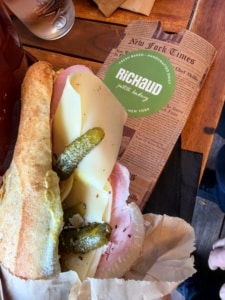
Our early morning had us heading first for ham-and-cheese sandwiches at Richaud Petite Bakery.
First, naturally, we needed to check whether Librae had made the breakfast focaccia we had been denied by Betty the previous morning. It had not, so we compensated by buying more croissants and cookies. Adaptability is important.
At the petite yet mighty Richaud, we shared the Instagram-famous sandwich, warm croissants and sugar brioche at a tiny outdoor bench in front of the adorable bakery.
Then to Saint George Boulangerie and Wine Bar.
Chocolate-chip cookies. Croissants. Ham-and-cheese croissants. Cinnamon rolls. Apple tartines.
Our bodies were beginning to revolt. I became convinced I was entering pancreatic failure.
Or some related organ failure event.
Still, lunch had to be decided. Bubba and I remained fixated on Ceres pizza. Geography killed it again.
Ceres was becoming our unicorn.
Instead, ABC Kitchen fit the route that had us ending the morning at Lysee.
On the way, we stopped at Fabrique for bags of pastries and cookies for later.
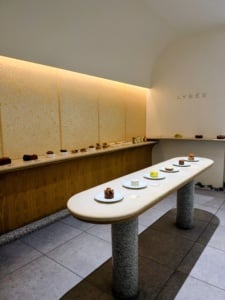
Lysée, where every beautiful pastry and cake has more personal space than most New Yorkers, is visually striking.
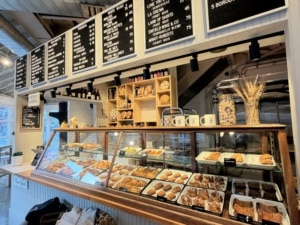
Another very different philosophy discussion for our crack team: Abundance versus scarcity. Warmth versus precision. Casual grabbing versus carefully curated selection.
All of it communicates something before the customer takes a single bite.
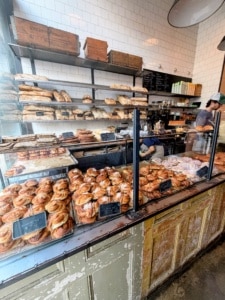
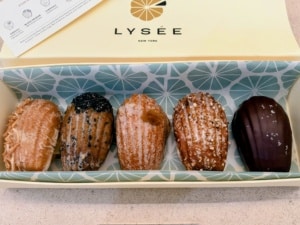
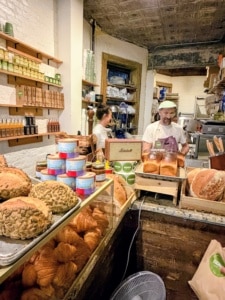
We bought cakes.
Again, for the all-important ‘later.’
At ABC Kitchen, everyone again attempted to introduce vegetables to see if their bodies outright rejected them.
I ordered pizza, mostly to annoy Betty while she ate kale and drank Champagne.
We skipped dessert because we are indeed responsible adults.
That lasted roughly thirty minutes, because back at the Bowery Hotel, surrounded by enormous bags and boxes of pastries, cakes and cookies, we took position in the lobby armed with plates and silverware, wine and tea (yuck) for Bubba, and started the actual autopsy.
Packaging. Branding. Structure. Crumb. Finish. Texture. How things traveled. What looked better in the store or the box than on the plate. What survived transport. What didn’t.
Bubba examined pastry construction. I photographed everything as evidence.
Then we spread it all out and ate. Again. 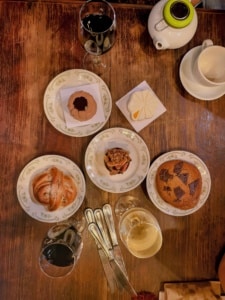
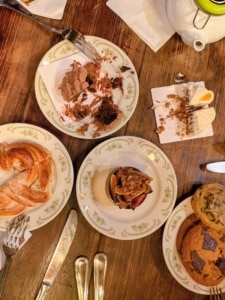
Lysée won this round.
THE PIZZA THAT ALMOST BROKE BETTY
Ceres still haunted Bubba and me. We left our tables full of desserts and promised it would be a happy hour goal. However, happy hour came only two hours after the dessert massacre. Even we had limits.
So we settled for a drink outside at The Wren, followed by dinner at Il Buco Alimentari.
This was an important stop because we wanted to see how a market concept successfully transitions into a full restaurant at night. Il Buco Alimentari has been around for years and was still absolutely packed on a Wednesday.
Another great learning using Odeon, Balthazar, ABC Kitchen and Il Buco: people often chase new. We were even more interested in what lasts.
Our table overlooked the kitchen and I noticed an oven in the back. After we ordered, I noticed pizzas coming out of it. Big, beautiful pizzas. One after another. And there was no pizza on the menu.
I called over the waiter.
“Are those pizzas?”
“Yes.”
“Can we have one?”
“Yes.”
Of course we could.
He recommended the spicy olive. I looked at Bubba. His eyes lit up.
Betty put her head on the table.
One spicy olive pizza coming up. I promised no dessert this time. 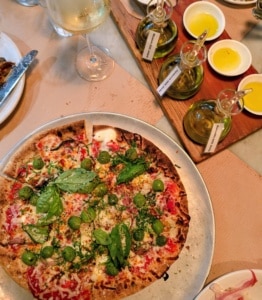
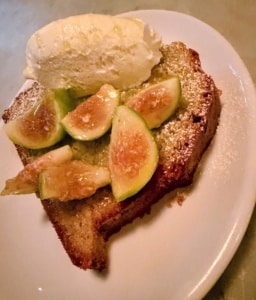
And I absolutely would have kept that promise.
Except Bubba and I saw olive-oil cake.
You cannot say no to olive-oil cake.
THE FINAL MORNING
Thankfully, our flight home meant a very short final day. (Although Bubba and Betty were headed to Chicago for continued research).
There was barely time for Black Seed bagel sandwiches and one last run to Librae.
And there it was. Breakfast focaccia. One unicorn down.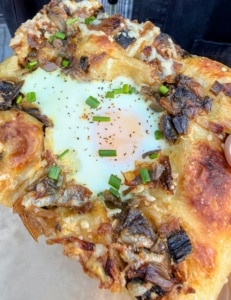
Ceres was the only one that remained undefeated.
SO WHAT DID WE ACTUALLY LEARN?
A lot.
And just as importantly, we reaffirmed a lot of what we already knew.
- Warm product matters.
- Seeing food come out of an oven matters.
- Abundance can be more seductive than treating every pastry like a precious product.
- Packaging is part of the experience, not what happens after it.
- Branding matters even more when someone walks out the door carrying it.
- Materials have to survive real life.
- Wood may look warm and beautiful in a bakery, but flour, grease, coffee and constant cleaning have opinions too.
- Seating dictates behavior.
- David coined the idea of the “twenty-minute chair” years ago. There are places where you want people to settle in and places where you absolutely do not. The chair can make that decision before the customer ever does.
- Lighting changes everything, for the better or worse.
- Display height changes what people notice.
- The first five feet inside the door matter, or with some of the NYC teeny tinies, the first one foot.
- So does the path to the coffee.
- So does where you stand while you wait.
- So does whether you can smell the bread.
- So does the box.
- The napkin.
- The menu.
- The trash can nobody thought about until it was too late.
The things people consciously notice and the things they never realize they’re noticing. That’s why we travel for research, why we photograph constantly, why we collect menus and packaging.
David sketches. We talk to people. We watch where customers sit, where they hesitate, what they order and what makes them reach for one more thing.
Because the best ideas rarely come from one grand revelation. They come from hundreds of tiny details you pick up along the way.
And no amount of scrolling through beautiful pictures can give you the smell, sound, movement, energy—or six warm pastries at 7:30 in the morning.
Some things you have to experience firsthand. And just because Instagram made it famous does not mean it will change your life. Don’t always believe the hype.
So yes, we came home slightly ill.
We also came home with hundreds of photographs, bags of packaging, too many opinions and a much clearer idea of what their new place should—and shouldn’t—be.
Sometimes research is measuring counters and studying customer flow. Sometimes it looks like four adults sitting in a hotel lobby drinking wine while dissecting twelve pastries and their packaging.
Both count.
The best way to learn is to go.
And apparently, sometimes you need to eat your way through Manhattan to figure out what you were looking for.
Ceres, we’re still coming for you.